




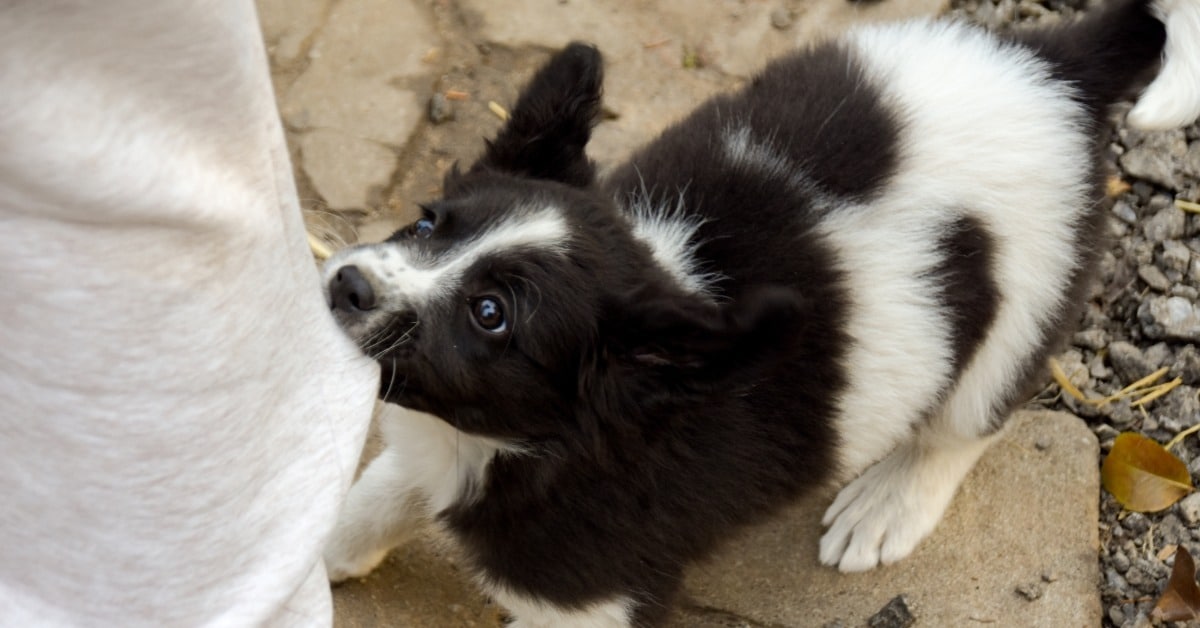
Your puppy came home sweet, soft, small and probably sleepy. Now your hands are covered in scratches, your sleeves are shredded, and every time you sit down you get a mouth full of teeth on your ankle. You start to wonder whether something is wrong with your puppy.
Nothing is wrong. Puppy biting is normal, it peaks at a predictable age, and it ends much faster when the whole household handles it the same way. Here is why it happens and what to do about it.
Why puppies bite so much
Puppies explore with their mouths. A puppy has no hands. Teeth are how a puppy tests texture, weight and reaction. Your fingers move, squeak and pull away, so they are the most interesting toy in the house.
Teething hurts. Between roughly three and six months, adult teeth push through and the gums ache. Chewing relieves that pressure, and your wrist happens to be the right size.
Play biting is how puppies learn limits. In the litter, when puppy bites another too hard, another yelps and play stops. When puppy tries this with their dog-mom, she educates them on what is appropriate. This is how a puppy learns to control their mouth. When a puppy leaves the litter early or plays only with people, that lesson is unfinished.
Overtired puppies bite hardest. The wild, shark-mouth phase most families see in the early evening is almost always exhaustion, not aggression. Puppies need anywhere from 16 to 20 hours of sleep a day and they rarely choose to take it.
It works. Biting gets attention, movement, noise and a game. Behaviour that works gets repeated.
What not to do
Do not hold your puppy’s mouth shut, tap the nose, pin the puppy down or shout. These raise the excitement, teach your puppy that hands are threatening, and push a confident puppy into biting harder.
Do not let children run away squealing. Running legs and high voices switch on the chase, and the puppy bites more, not less.
Do not wrestle with your hands. A game where hands are the toy teaches exactly what you are trying to stop.
Do not wait it out and hope teething ends the problem. Teething ends, habits do not.
What actually works
- End the game the moment teeth touch skin. Freeze your action and stop playing. If teeth on skin consistently means the fun stops, puppies start learning the right lesson.
- Put something legal in the mouth first. Carry a chew or a soft toy and offer it before the mouth finds you, especially at greetings and when children come home from school.
- Protect the sleep. A puppy who bites furiously at 7pm usually needs a quiet crate or pen, not more exercise. Build a naps into the day, particularly in the afternoon and the evening.
- Use chews that suit teething. Something cool and firm, sized for your puppy, and served in the pen so it does not turn into a chase.
- Get everybody consistent. One person ending the game calmly and three people screaming and flapping their hands keeps the biting going for months. Write the rule on the fridge if you have to.
- Coach the children. Small hands and fast movement are irresistible. Teach children to stand still like a tree, tuck their hands in and call an adult instead of running. Remember, dogs and children should ALWAYS be supervised, regardless of the dog’s age.
- Teach calm as a skill. Bark Busters training uses voice tone and body language to show your puppy how to settle and take direction from you, without force. A puppy who learns to switch off does not need to chew on you to find out what happens next.
How long does it take
Teething typically finishes at around six months, and by then a puppy who has had consistent boundaries usually mouths much less or not at all. Puppies who left the litter early, or who live with excited young children, take a bit longer, and that is normal. Many herding dogs (ie: dogs bred to get livestock moving with their mouths like Shepherds, Collies, Cattle Dogs, or Corgis) can tend to be nippier, and take a bit more of a prolonged and structured approach.
When to ask for help
Ask for help immediately if the biting breaks skin, if your puppy growls, freezes or stiffens rather than plays, if your puppy bites when you reach for food, a bed or a toy, or if you have children, elderly or ill people in your home. None of this beahviour means you have a bad puppy, but means the pattern needs a trained pair of eyes.
This is why in-home training matters. Puppy biting happens in your hallway, on your sofa and at your back door, with your family, at the times of day your household gets busy. That is where it needs to be worked on – with everyone involved.
Overall
Your puppy is not aggressive and you are not failing. Your puppy is using teeth because teeth work. Give the mouth a better job, end the game the instant skin gets touched, protect the sleep, and keep every person in the house doing the same thing.
Every Bark Busters program comes with our Life Of Dog Support Guarantee, so your trainer stays with you and your dog for the life of your dog, not just the first lesson.
If your puppy’s biting is wearing the family down, find your local Bark Busters trainer and book an in-home lesson.
Find Your Local Trainer