



Your dog talks to you all day long. Most of it happens before a single bark, and most of it goes straight past us because we are watching for the wrong things.
Dogs communicate with their whole body. Ears, eyes, mouth, tail, weight, speed and stillness all carry meaning, and they change from second to second. Once you can read those signals, you stop being surprised by your dog. You see the worry before the growl, the excitement before the jump, and the discomfort before the snap.
Here is what your dog is actually telling you, and how to answer.
Read the Whole Dog, Not One Body Part
The single most common mistake owners make is reading one signal in isolation. It is also why so many owners read a lowered head as guilt, and our post on whether dogs really feel shame or guilt clears that up. A wagging tail on a stiff, forward-leaning dog means something very different from a wagging tail on a loose, wiggly dog. A yawn in a warm living room means one thing, and a yawn at the vet means another.
Before you decide what a signal means, take in three things:
- The whole body. Loose and curvy, or stiff and straight?
- The context. What just happened, and who else is in the room?
- The change. What did your dog look like ten seconds ago, and what changed?
The Tail Tells You About Arousal, Not Mood
A tail says how much energy your dog is holding and how they feel about the thing in front of them. Height matters more than movement.
- Neutral, mid-height, loose sweeps: comfortable and relaxed.
- Big, low, whole-body wag: friendly, often the classic happy greeting.
- High and stiff, small fast flicks: alert and aroused. This dog is deciding something, and it is not always friendly.
- Tucked under the body: frightened or trying to disappear.
- Still and held out straight: intense focus, often the moment before a reaction.
Docked tails and naturally curly tails (like in Spitz breeds) make this harder to read, which is why the rest of the body matters so much.
Ears, Eyes and Mouth Give You the Detail
The face fills in what the tail leaves out.
Ears
Forward means interest or challenge. Back and flat against the head means worry or appeasement. Ears flicking back and forth mean your dog cannot decide, which is a good moment to give them space.
Eyes
Soft eyes with regular blinking mean a relaxed dog. A hard, unblinking stare means your dog has locked on and is serious. If you can see the whites of the eyes as a crescent because your dog has turned their head but kept their eyes on something, that is whale eye, and it is a clear request to back off. Looking away is polite in dog language, not rude.
Mouth
A loose, slightly open mouth belongs to a comfortable dog. A closed, tight mouth with tension at the corners means your dog has gone on alert. Panting with no heat and no exercise usually means stress. Lip licking when there is no food around, and a big yawn when nobody is tired, are two of the clearest stress signals your dog has, and they are also two of the most commonly missed. Licking that carries on for hours is a different problem, and we cover it in why a dog licks his legs all night.
Posture and Weight
Watch which way your dog leans. Weight forward over the front legs means engagement, either play or confrontation. Weight shifted back means your dog wants distance. A dog who has gone completely still while staring is not calm, and that stillness is often the last warning before a snap. When those warnings turn into real threats, read what you need to know about dog aggression.
Raised hackles along the shoulders and spine are involuntary. They mean arousal, not aggression. A very excited dog and a very worried dog can both raise their hackles.
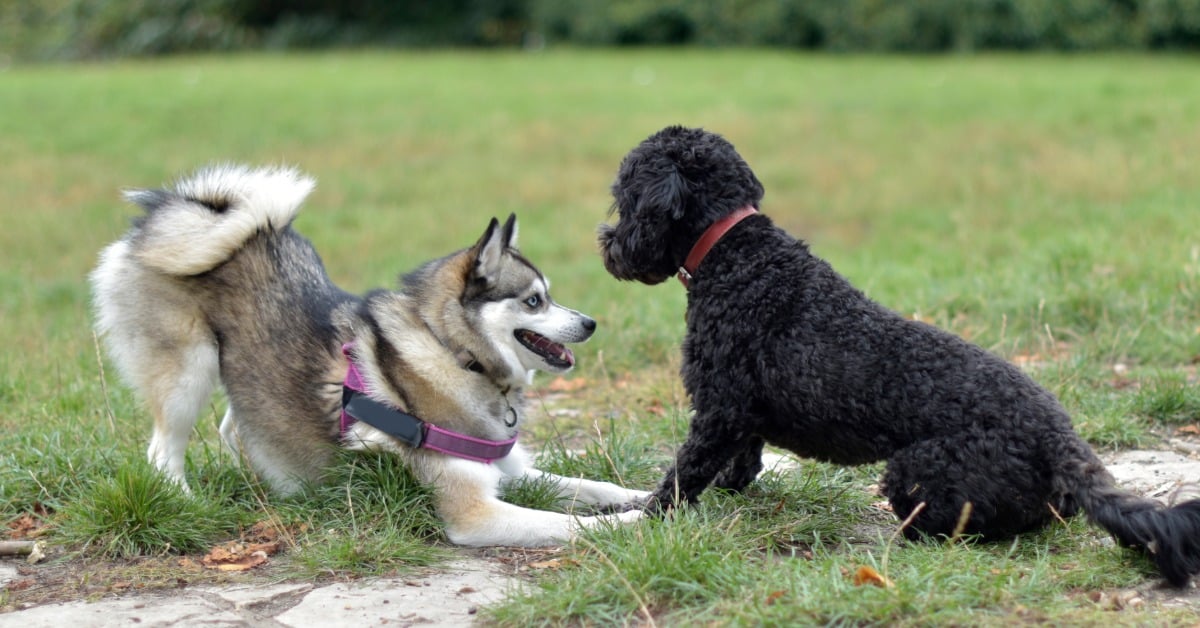
A play bow, with elbows down and bottom up, is an invitation. Rolling onto the back can be an invitation too, but if the mouth is tight, the tail is tucked and the body is frozen, that dog is not asking for a belly rub. They are asking the interaction to end.
The Signals Owners Miss Most
Dogs almost never bite without warning. They warn quietly first, and when we ignore those quiet warnings or tell them off, they escalate. Learn these early ones:
- Turning the head or body away from a person or dog
- Lip licking with no food present
- Yawning when your dog is not tired
- Shaking off as if wet after a stressful moment, which is a reset button
- Sniffing the ground suddenly in a tense situation
- Slowing down or freezing as another dog approaches
- Scratching out of nowhere
These are all polite ways of saying “I need a moment.” Give your dog that moment, and you build trust. Push through it, and your dog learns that quiet signals do not work.
What Play Looks Like, and When It Stops Being Play
Good play is loose, bouncy and full of pauses. Dogs take turns, swap who chases whom, and break naturally every few seconds. Bodies stay curved and movements look exaggerated.
Step in when the pauses disappear, when one dog is always the target and keeps trying to leave, when the bodies stiffen and the play gets quiet, or when one dog pins the other and will not let up. A calm interruption early keeps a good relationship intact. Waiting to see whether they sort it out is how fights start.
Your Body Language Talks Too
Your dog reads you far more closely than you read them. A few things you are probably saying without meaning to:
- Leaning over a dog and reaching for their head feels threatening to most dogs. Turn side on, crouch, and let them come to you.
- Hugging is a primate gesture. Many dogs tolerate it, few enjoy it. Watch for the tight mouth and the turned-away head.
- Tightening the leash and going silent when you see another dog tells your dog there is something to worry about.
- Fast, high-pitched excitement winds a dog up. Slow movement and a low, calm voice settle them.
How to Practise This Week
Spend five minutes a day just watching your dog with nothing else going on. Watch them settle, watch them hear the mail carrier, watch them greet you. If your dog never truly settles and follows you from room to room all day, the body tells you whether that is habit or worry. Notice what their genuinely relaxed body looks like, because that is your baseline for everything else.
Then film a walk or a play session on your phone and watch it back with the sound off. Signals you miss in the moment become obvious on a second viewing, and the video shows you your own body language too.
When to Call a Professional
Get help if your dog freezes or stares at family members, growls over food, toys or furniture, shows aggression toward people or other dogs, shows whale eye when handled, cannot settle after normal daily events, or reacts hard to dogs and people on walks. Those are conversations worth having early rather than late.
Bark Busters trainers come to your home, where your dog is most themselves. We show you what your dog is saying, in your own living room and on your own street, and give you a method for answering in a way your dog understands. Our work builds on natural canine communication, and it pairs naturally with your everyday interactions, so you are not teaching tricks. You are learning your dog’s language.
The Bottom Line
Your dog has been telling you how they feel their whole life. Read the whole body, respect the quiet signals, and watch what you are saying back. Owners who learn to listen this way end up with calmer dogs, because the dog no longer has to shout.
Every Bark Busters training program comes with our Life Of Dog Support Guarantee, so you have support for as long as you need it.
Find your local Bark Busters trainer and start understanding what your dog is telling you.
Find Your Local Trainer