



You will find a new normal. Your dog will adjust to life with a baby if you give it time and consistency, but the transition goes much more smoothly when you prepare ahead, understand dog body language, and set realistic expectations about what dogs and babies can safely share.
At Bark Busters, we work with growing families across Canada who want to ensure their dog and new baby can coexist safely. Our Written Lifetime Guarantee means we’ll be there as situations change, from having a baby to your child’s first steps and beyond. Here’s everything you need to know.
Key Takeaways
• Address jumping and front door/window barking before baby arrives—you’ll be happier when baby is napping, with a quiet dog.
• Dogs need structure and boundaries around babies; don’t expect them to be instant best friends who share everything.
• Learn to recognize appeasement signals like lip licking and “whale eye” (showing the whites of the eyes). These indicate your dog wants more space, not that they’re being affectionate
• Behavioural regression (accidents, destructive behaviour, acting out) after the baby arrives is common and typically caused by routine changes, new sounds and smells, and different attention levels
• The rule for dog-baby interactions: “The dog only interacts with the baby with an adult present,” and dogs should not be in the baby’s face
Before Baby Arrives: Priority Behaviours to Address
You have a limited window to address training issues before the exhaustion of new parenthood sets in. Focus your energy on the behaviours that will be most problematic or dangerous once the baby arrives.
Priority behaviours to fix before the baby comes:
• Jumping on people
• Barking at the door or windows
Paws on people or furniture may have been annoying before. Now it’s dangerous. If your dog jumps on everyone who walks through the door, imagine holding a newborn when that happens.
Jumping is typically one of the simplest problems to fix. If you have four months until the baby arrives, that’s plenty of time to address this behaviour with consistent training.
Door and window barking is another priority. A dog who barks every time someone walks by or every time a delivery arrives will wake your sleeping baby repeatedly throughout the day. Address this now, while you have the time and energy. Our basic obedience training covers jumping, door behaviour, and the foundational skills that make life with a newborn much easier.
What to Expect: Common Behavioural Issues After Baby Arrives
The most common concern we hear from new parents is about aggression & overexhuberance; they’re worried their dog might harm the baby, accidentally or on purpose. This is a legitimate safety consideration, and it’s why preparation and supervision matter so much.
But many of the behaviour changes you’ll see aren’t about aggression at all. They’re about adjustment.
Why dogs might act out after baby arrives:
When your baby comes home, your dog experiences a massive change in routine, new and unfamiliar sounds (crying, cooing, musical toys), different smells (diapers, formula, lotions, powders), and significantly different levels of attention from you.
This can result in accidents in the house (even if your dog was fully house-trained), destructive behaviour, acting out in ways they never did before, and attention-seeking behaviours.
This is normal. It doesn’t mean your dog is “bad” or can’t adjust. It means they’re experiencing stress from major changes and need time, consistency, and understanding to find their new normal.
“My Dog Seems Jealous”: Understanding Attention-Seeking Behaviour
Your dog used to be the centre of your world. Now there’s a tiny human who demands your constant attention. Many dogs respond by acting out—doing things they’ve never done before, seeking attention in problematic ways, or seeming to deliberately misbehave.
Is this jealousy? Not exactly. Your dog is responding to a dramatic shift in their access to you.
Can this be avoided? Yes, with some work ahead of time. If you gradually adjust your dog’s routine and attention levels before the baby arrives, the transition won’t be as jarring. Start varying your routine a little with your dog. For example, if your dog is always walked at 5 pm, vary a little to 5:30 or 6 pm. Small shifts, within reason, teaches your dog that things will still happen, just on your terms.
And remember: focus on quality over quantity. You may have less time for your dog, but you can make the time you do have meaningful.
Reading Your Dog’s Body Language Around The Baby: What Parents Get Wrong
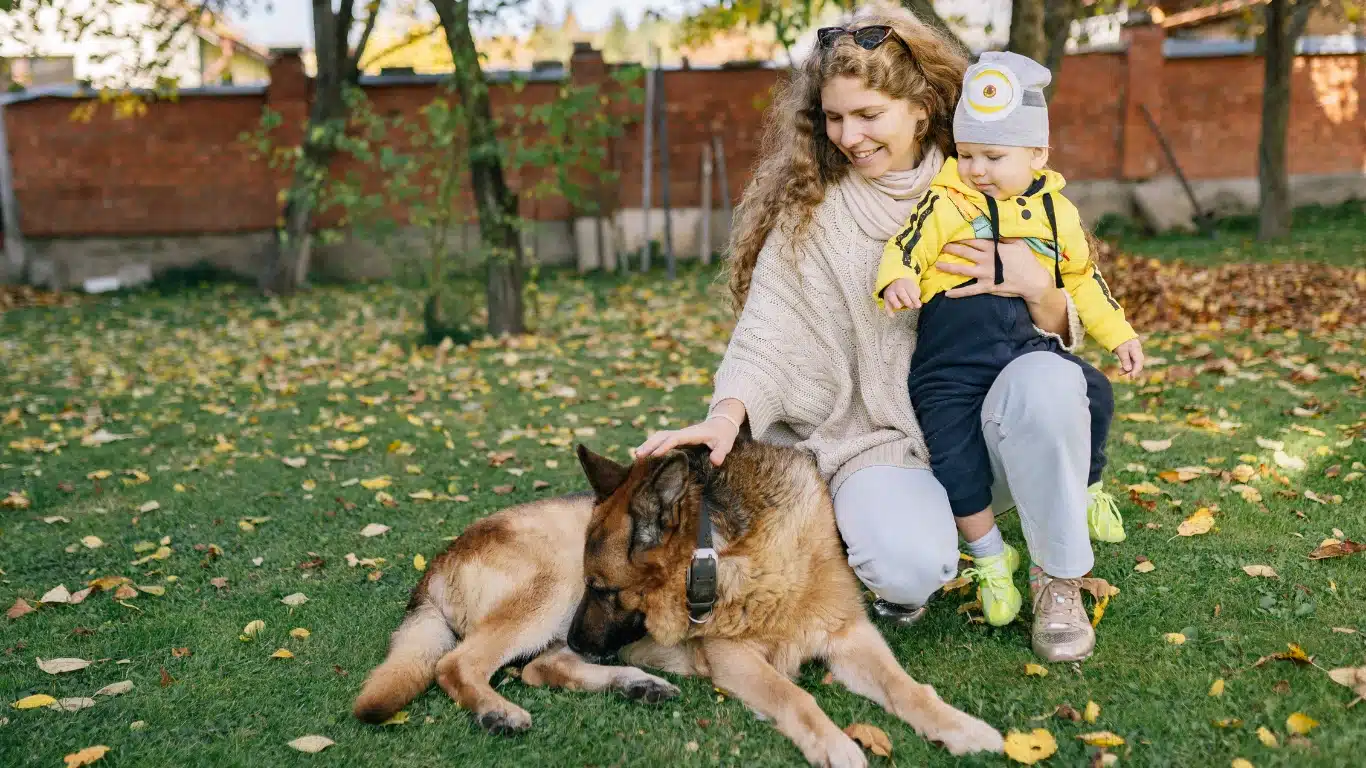
One of the most dangerous misunderstandings new parents make is misreading their dog’s body language around the baby. Certain signals that look harmless, even affectionate, are actually your dog’s way of saying they need more space.
Appeasement signals to watch for:
Licking can be a stress signal. If the body is tight, and the dog gives a quick lick or two, and moves away, your dog isn’t being cute or showing affection; they’re communicating discomfort.
“Whale eye” is when your dog turns their head away but keeps their eyes fixed on something, causing you to see the white crescent of their eye. This is a significant stress signal indicating your dog is uncomfortable with the current situation.
Yawning (when not tired) is another calming signal dogs use when they’re stressed.
These signals indicate your dog wants more space, not more interaction. When parents interpret licking or close attention as affection and allow it to continue, they may be missing their dog’s polite request to be left alone, which can eventually escalate to growling or snapping if the dog feels their signals are being ignored.
Warning Signs: When Your Dog Is NOT Safe Around the Baby
Not all dogs are suited for life with infants, and some situations require immediate professional intervention.
Warning signs that indicate a safety concern:
• High levels of aggression or stress around strangers and children, consistently, even when given space
• Stiff body posture, hard staring, growling, or snarling when near the baby
• A dog that cannot be redirected or calmed when the baby is present
• Lunging, snapping, or attempting to make contact with the baby in an aggressive manner
Normal adjustment stress looks different. A dog who is mildly anxious but can be redirected, who shows stress signals but responds when given space, or who needs time to acclimate but isn’t displaying overt aggression—this is typical adjustment behaviour.
If you’re seeing consistent aggression or high-level stress that doesn’t improve with space and time, this is not something to manage on your own. Find your local Bark Busters trainer to get professional help immediately.
“My Dog Is Obsessed With the Baby”: Affection or Concern?
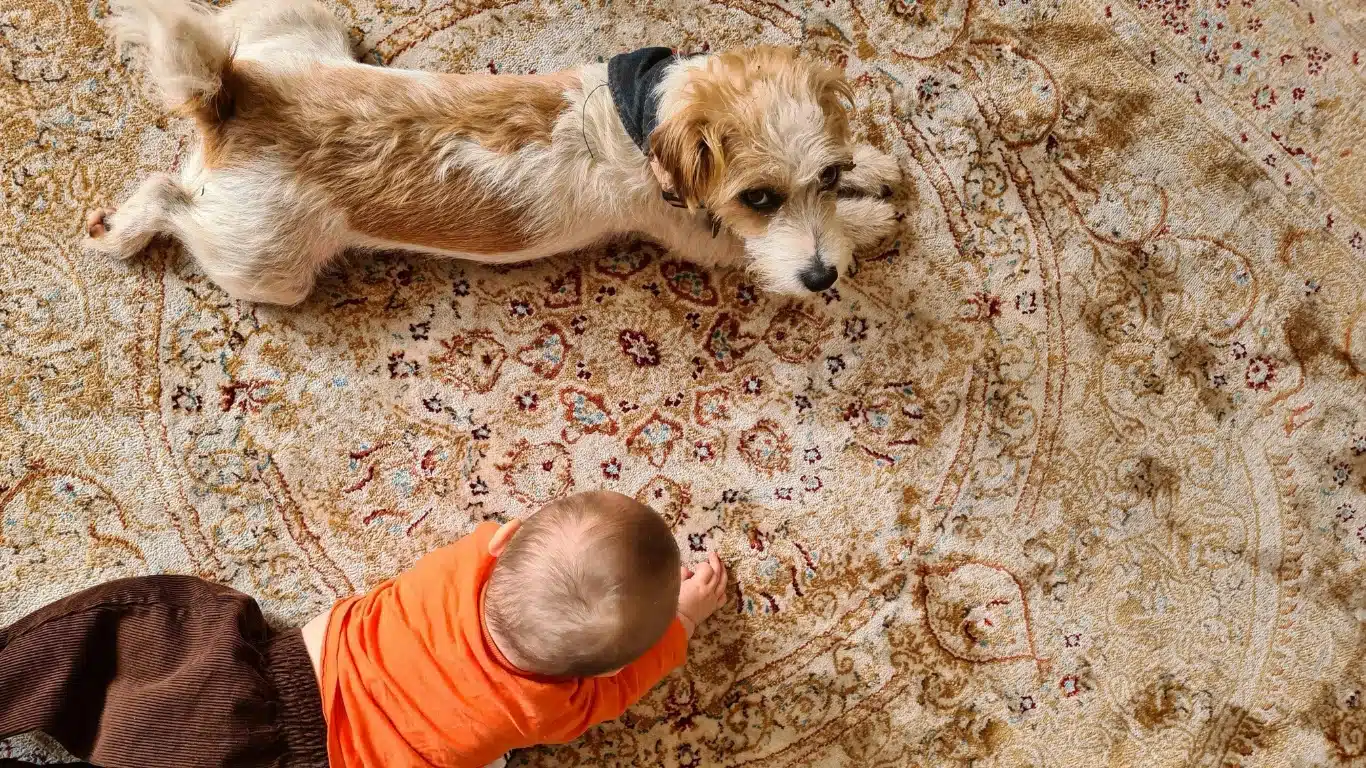
Your dog constantly sniffs the baby, licks them, and won’t leave them alone. Is this love or something to worry about?
Not necessarily concerning, but boundaries are essential.
The rule we recommend: The dog only interacts with the baby with an adult present. Period.
Additionally, dogs should not be in the baby’s face. Close face-to-face contact between dogs and infants is risky, even with the most well-intentioned dog. A dog can react unexpectedly, and babies are extremely vulnerable.
Set clear boundaries about where your dog can be when the baby is present. Your dog may be curious and even protective, but they still need structure around how and when they can be near the baby.
When the Crying Sets Your Dog Off
Many dogs react to baby crying, barking, whining, pacing, or showing signs of distress. What does this mean?
Reactions depend on the individual dog. Crying is a new sound, and it can be stressful for dogs who aren’t used to it. Some dogs bark because they’re alarmed. Others whine because the sound distresses them. Some may be trying to alert you that “something is wrong” with this small creature.
Before the baby arrives, you can help prepare your dog by playing recordings of the baby crying at low volumes, gradually increasing over time. This can help reduce the shock of the real thing.
If your dog’s reaction to crying is extreme—excessive barking, pacing, or signs of significant stress—consult with a Bark Busters trainer. You’ll be dealing with enough crying without your dog adding to the chaos.
The Progression: From Newborn to Toddler
The risks and training needs change as your baby grows. What works when the baby is immobile in a bassinet won’t work when they’re crawling across the floor toward your dog.
Newborn stage: Your baby doesn’t move independently. Supervision is still essential, but the main concern is the dog approaching the baby, not the other way around.
Crawling stage: Now your baby is on the move. They may crawl toward the dog, reach for the dog’s face, grab fur or ears, or corner the dog in spaces where the dog feels trapped. Supervision needs increase significantly.
Toddler stage: Toddlers are unpredictable, uncoordinated, and don’t understand gentle handling. They may grab, poke, pull, or startle your dog in ways that can trigger a defensive reaction—even from a normally patient dog.
A baby on the move needs more supervision. And crucially, your dog needs to be trained well and have a safe place to go that is inaccessible to the child. This might be a room with a baby gate the dog can access but the child cannot, a crate in a quiet area, or elevated spaces where the dog can retreat.
If your dog feels they have no escape from an approaching toddler, they may feel cornered, and cornered dogs can react defensively.
Common Mistakes New Parents Make
Even well-intentioned parents can accidentally create problems between their dog and baby. Here are the most common mistakes:
Expecting the dog and the baby to be best friends. Dogs and babies are not always natural playmates. They shouldn’t share toys, beds, or spaces without clear boundaries and supervision.
Allowing the dog to be in the baby’s face. This is risky regardless of how gentle your dog seems.
Leaving the dog and the baby together unsupervised. Even “just for a second.” Even with a dog who has never shown any concerning behaviour. Always supervise.
Ignoring appeasement signals. When your dog licks their lips, shows whale eye, or turns away, they’re asking for space. Honour that request.
Punishing the dog for normal adjustment behaviours. If your dog has accidents or acts out after the baby arrives, punishment will only add stress to an already stressful situation. Be patient. A baby is a big adjustment for everyone!
Completely neglecting the dog’s needs. Yes, you’re exhausted. But a dog who receives no exercise, no attention, and no mental stimulation will develop behaviour problems.
If you’re expecting and have a puppy, our puppy training program can help you establish good habits before the baby arrives—setting everyone up for success.
“I Barely Have Time to Walk Him”: Maintaining Your Dog’s Well-being
Your dog used to be your whole world. Now you can barely find time to take them around the block. Is your dog depressed? Do they hate you?
Absolutely not.
Dogs are adaptable. They don’t hold grudges, and they don’t resent you for having a baby. What matters is how you structure the time you do have.
Focus on quality over quantity. A shorter, more engaged walk is better than a long walk where you’re distracted and exhausted. Brief training sessions, puzzle feeders, and meaningful interactions can partially compensate for reduced exercise.
Some practical strategies for busy new parents:
• Hire a dog walker for the early weeks when you’re most exhausted
• Ask family or friends to help with dog walks
• Use puzzle feeders and enrichment toys to provide mental stimulation when you can’t provide physical exercise
• Build brief, positive interactions into your routine—even just a few minutes of focused attention helps
Your dog will adjust to the new normal. Give them time and consistency.
When to Get Professional Help
Don’t wait for a crisis. Growing families benefit from proactive training support before baby arrives or during the early adjustment period.
Certainly, if you’re seeing any of the warning signs described above (consistent aggression, high stress around the baby that doesn’t improve, or any concerning behaviour), don’t wait. Contact a Bark Busters trainer immediately.
Bark Busters trainers work in your home, which means we can observe the actual dynamics between your dog and your family and provide guidance tailored to your specific situation. Find your local Bark Busters trainer to discuss preparing your dog for your growing family.
The One Thing Every Expectant Family Should Understand
You will find a new normal.
Many of our trainers are parents themselves. We’ve been there! You may feel guilty about having less time for them. There will be moments of stress and uncertainty.
But your dog will adjust if you give them time and consistency. Dogs are remarkably adaptable creatures, and most dogs successfully integrate into families with babies and young children.
The families who struggle most are those who expect the transition to be seamless, who don’t prepare, or who don’t set appropriate boundaries between dog and baby. The families who succeed are those who plan ahead, maintain realistic expectations, supervise consistently, and understand that adjustment takes time for everyone, dogs included.
Frequently Asked Questions
My dog jumps on everyone. We have four months until the baby arrives. Is that enough time to fix this? Yes. Jumping is typically one of the simplest problems to fix. Four months is plenty of time to address this behaviour with consistent training before the baby arrives.
Why is my dog having accidents in the house after we brought the baby home? This is typically caused by the massive changes in routine, new sounds and smells, and different attention levels your dog is experiencing. It’s a stress response, not spite. Maintain consistent routines as much as possible and give your dog time to adjust.
My dog keeps licking the baby. Is this affection? Not necessarily. Licking and close attention can actually be appeasement signals—your dog’s way of saying they’re uncomfortable and want more space. Watch for “whale eye” (showing the whites of the eyes) and other stress signals. Set the boundary that the dog only interacts with the baby with an adult present, and keep the dog away from the baby’s face.
My dog barks every time the baby cries. Is this protective behaviour? Reactions to crying depend on the individual dog. Crying is a new sound that can be alarming or stressful for dogs.
Do we need to keep our dog and baby separated forever? Not necessarily, but supervision is always required. Many families eventually reach a point where dog and child coexist comfortably with minimal intervention, but this takes time, training, and appropriate boundaries.
How do I know if my dog is genuinely unsafe around my baby, versus just adjusting? Warning signs of a genuine safety concern include consistent high levels of aggression or stress around the baby, stiff body posture, hard staring, growling, snarling, or any behaviour that doesn’t improve when the dog is given space. If you’re seeing these signs, contact a professional trainer immediately.