




The best strategy to stop a dog from chasing cats in the home combines understanding what’s driving the behaviour (play versus prey drive), establishing physical barriers and safe spaces for your cat, building solid voice control with your dog, and never leaving the animals unsupervised until you’re certain they can coexist peacefully. Most dogs and cats can learn to live together—but tolerance is the realistic goal, and friendship is entirely up to the animals.
At Bark Busters, our trainers work with multi-pet households every day, and many have both dogs and cats themselves. For the bigger picture, read our post on whether dogs and cats can get along. Here’s what actually works.
Key Takeaways
• Cat-chasing typically falls into two categories: play/overzealous interest (more common) or true prey drive (the instinct to chase, attack, and capture)
• Most dogs and cats can eventually coexist, but a small percentage of dogs have prey drive too high to safely live with cats
• Loose, wiggly body language from a dog suggests play; stiff posture, staring, growling, or snarling indicates something more serious
• Cats should always have escape routes—high perches or cat doors to dog-free areas
• Never yell, chase your dog, or physically punish them during a chase—this makes the behaviour worse
• Younger dogs are generally more adaptable, but older dogs can learn new behaviours too
Is It Play or Prey Drive? Understanding Why Your Dog Chases the Cat
Before you can address cat-chasing, you need to understand what’s motivating it. Not all chasing is the same, and the approach depends on what’s actually happening.
Play behaviour and overzealous interest are the more common causes. These dogs are excited, curious, and want to engage with the cat; they just don’t understand that the cat isn’t enjoying the interaction. You’ll typically see loose, wiggly body language, play bows, and a dog who can be redirected with some effort.
True prey drive is different. This is the instinct to chase, capture, and potentially harm another creature. Dogs displaying prey drive show stiff posture, intense staring, may growl or snarl, and are extremely difficult to interrupt once locked onto the cat.
The distinction matters because play behaviour can often be managed and redirected through training, while very high prey drive may require permanent management and separation.
When a Peaceful Household Suddenly Changes
One of the most confusing scenarios for owners is when a dog suddenly starts chasing a cat they’ve lived with peacefully for months or years. If this happens, the first question to ask yourself is: what else has changed?
Consider recent changes like moving to a new home, renovations or construction, changes in food or litter box locations, new family members or pets, or changes in household routines. Environmental stress can trigger behavioural changes in both dogs and cats. Typically, dogs chase cats when they’re new to living together—so sudden chasing in an established household often points to something else going on that needs to be addressed.
If you can’t identify any obvious trigger and the behaviour persists, it’s worth having both animals checked by a vet to rule out any health issues that might be affecting their behaviour.
How to Introduce (or Reintroduce) Dogs and Cats
Whether you’re bringing a new pet into the home or need to essentially start over after a breakdown in the relationship, a structured introduction process gives you the best chance of success.
Start with complete separation. Dogs and cats should be kept apart while the new animal acclimates to the home. Use doors and baby gates to create distinct zones. This initial period lets everyone settle without the stress of direct contact.
Create cat-safe spaces. Your cat will need an ‘escape’ where the dog cannot follow and a safe place to put food & litter boxes.
Build voice control first. Before allowing face-to-face meetings, make sure you have reliable recall and basic obedience from your dog. You need to be able to interrupt and redirect your dog when things get too intense. Without this foundation, introductions become much riskier.
Introduce through a barrier. The first meeting should happen with a baby gate or similar barrier between the animals. Let them see and sniff each other, but allow both to move away if they choose. Don’t force interaction—let it happen naturally.
Expect some cat drama. Some hissing from cats is completely typical and doesn’t mean the introduction is failing. Cats are naturally more wary creatures, and they need to set the pace. Push too fast, and you risk stress-related problems (including, yes, your cat potentially peeing in your shoes to express their displeasure).
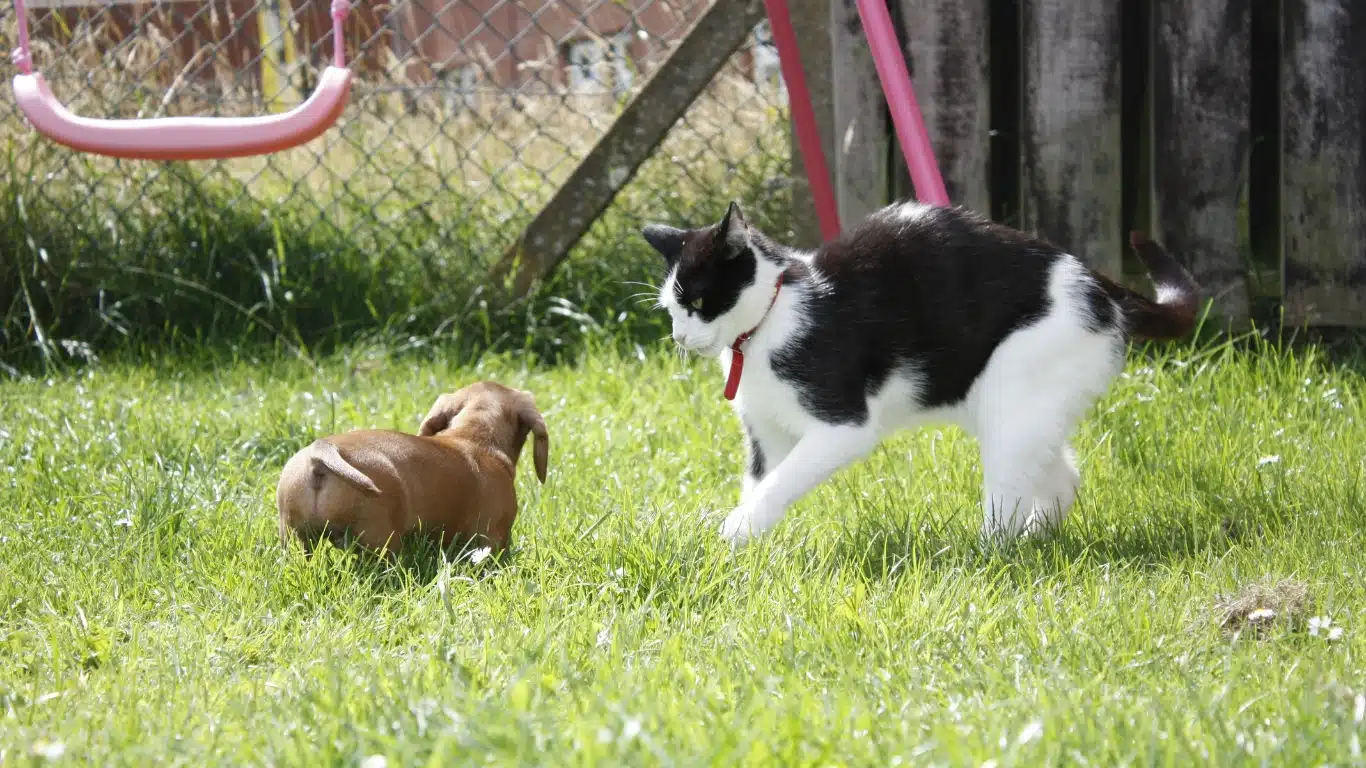
Can Cat-Chasing Be Fully Eliminated?
This depends entirely on the individual cat and dog. Most animals can be integrated eventually, keeping in mind that some cats take months or even years to fully warm up to a dog. Tolerance is the realistic goal—genuine friendship is up to the animals themselves.
However, there is a small percentage of dogs that simply cannot live safely with cats. Their prey drive is too high. In these cases, the behaviour can be managed through training, containment, and constant supervision, but the underlying instinct cannot be removed. These dogs and cats can coexist in the same household, but they may never be able to share unsupervised space.
A Bark Busters trainer can help you assess your specific situation and determine what’s realistic for your household.
Warning Signs: When Cat-Chasing Becomes Dangerous
How do you know when a dog’s cat-chasing has crossed from nuisance behaviour into genuinely dangerous territory?
Body language tells the story. Loose, wiggly body language from a dog says “play.” Stiff posture, intense staring, growling, or snarling says “I’m unhappy” or worse. If you’re seeing the latter, this is serious.
Don’t wait to figure it out. Every situation is different, and it’s not worth risking your cat’s safety while you try to diagnose the problem yourself. If you’re seeing concerning behaviour—or if you’re simply unsure—reach out to a nearest Bark Busters trainer sooner rather than later.
Many Bark Busters trainers have experience with exactly this situation. They can help you read the signals and develop an appropriate plan.
What Owners Do Wrong During a Chase
When your dog takes off after the cat, your instincts may lead you astray. Here’s what not to do:
Don’t yell. Shouting often sounds like excited barking to your dog, which can actually increase their arousal and intensify the chase.
Don’t chase your dog. Now you’ve turned it into a group activity. Your dog thinks everyone is joining the fun.
Don’t physically punish the dog. Grabbing, scruffing, or pinning your dog won’t teach them anything useful about cats—it will just damage your relationship and potentially make them more reactive.
Instead, use the voice control you’ve been building. A calm, firm recall or interruption cue is far more effective than panicked yelling. If you don’t yet have reliable voice control, that’s where your training efforts need to focus.
What About Breed Considerations?
Are certain breeds essentially a lost cause when it comes to living peacefully with cats? The short answer is: it’s more about the individual dog than the breed.
Yes, some breeds were developed with stronger prey drives—terriers bred for ratting, sighthounds bred for coursing, and so on. But within any breed, you’ll find individual dogs who get along beautifully with cats and others who never will.
Age also plays a role. Generally, a younger dog has had less time to form ingrained habits and is more adaptable to new situations and expectations. But you absolutely can teach an older dog new behaviours—it may just take more patience and consistency.
If you have a dog who has been chasing cats for years, expect the process to take longer, but don’t assume it’s impossible.
When Can Dogs and Cats Be Left Alone Together?
Many dogs and cats eventually reach a point where they can coexist happily without owner supervision. But getting there requires patience, and some households will never reach that point.
If you’re at all unsure, separate when you’re not home. This might mean crating the dog, using baby gates to keep them in different areas, or confining one animal to a specific room.
Always ensure your cat has escape routes. Even in the most harmonious multi-pet households, your cat should always have access to high perches or cat doors leading to dog-free areas. This gives them options if they need space.
The progression toward unsupervised time together depends on consistently peaceful supervised interactions over an extended period. Don’t rush it—a setback can be difficult to recover from.
Getting Professional Help
If you’re struggling with a dog who chases your cat, you don’t have to figure it out alone. Every situation is different, and what works for one household may not work for another.
Bark Busters trainers work in your home, where the behaviour actually happens, and can assess the specific dynamics between your pets. Many of our trainers have navigated this exact challenge with their own animals and can offer practical, real-world guidance tailored to your situation.
Contact your local Bark Busters trainer to discuss your multi-pet household and develop a plan that works for everyone—humans, dogs, and cats alike.
Frequently Asked Questions
Why does my dog suddenly chase my cat after years of living together peacefully? When established relationships suddenly change, look for environmental triggers: recent moves, renovations, changes in food or litter box locations, new family members, or schedule changes. Stress can affect both animals’ behaviour. If you can’t identify a cause and the behaviour persists, have both pets checked by a vet.
Can dogs with high prey drive ever live safely with cats? Most dogs can learn to coexist with cats through training and management. However, a small percentage of dogs have a prey drive too high to safely share unsupervised space with cats. In these cases, the instinct can be managed but not eliminated—meaning permanent separation protocols when you’re not actively supervising.
How do I know if my dog is playing with the cat or being aggressive? Body language is your guide. Play typically involves loose, wiggly body language and a dog who can be interrupted and redirected. Concerning behaviour includes stiff posture, intense staring, growling, snarling, or a dog that completely ignores you when focused on the cat.
How long does it take to introduce a dog and a cat? There’s no set timeline—it depends entirely on the individual animals. Some dogs and cats settle into comfortable coexistence within weeks. Some cats take months or even years to fully warm up to a dog. Let both animals set the pace, and don’t rush the process.
Should I keep my dog on a leash inside the house during introductions? Yes, using a leash or dragline indoors during the early days of introduction is a common and effective strategy. It gives you immediate control if things escalate without relying solely on voice commands.
Do I need to keep my dog and cat separated forever? Not necessarily. Many dogs and cats reach a point where they can share space without supervision. However, some households will always require management. Even in harmonious homes, ensure your cat always has escape routes to dog-free areas.